

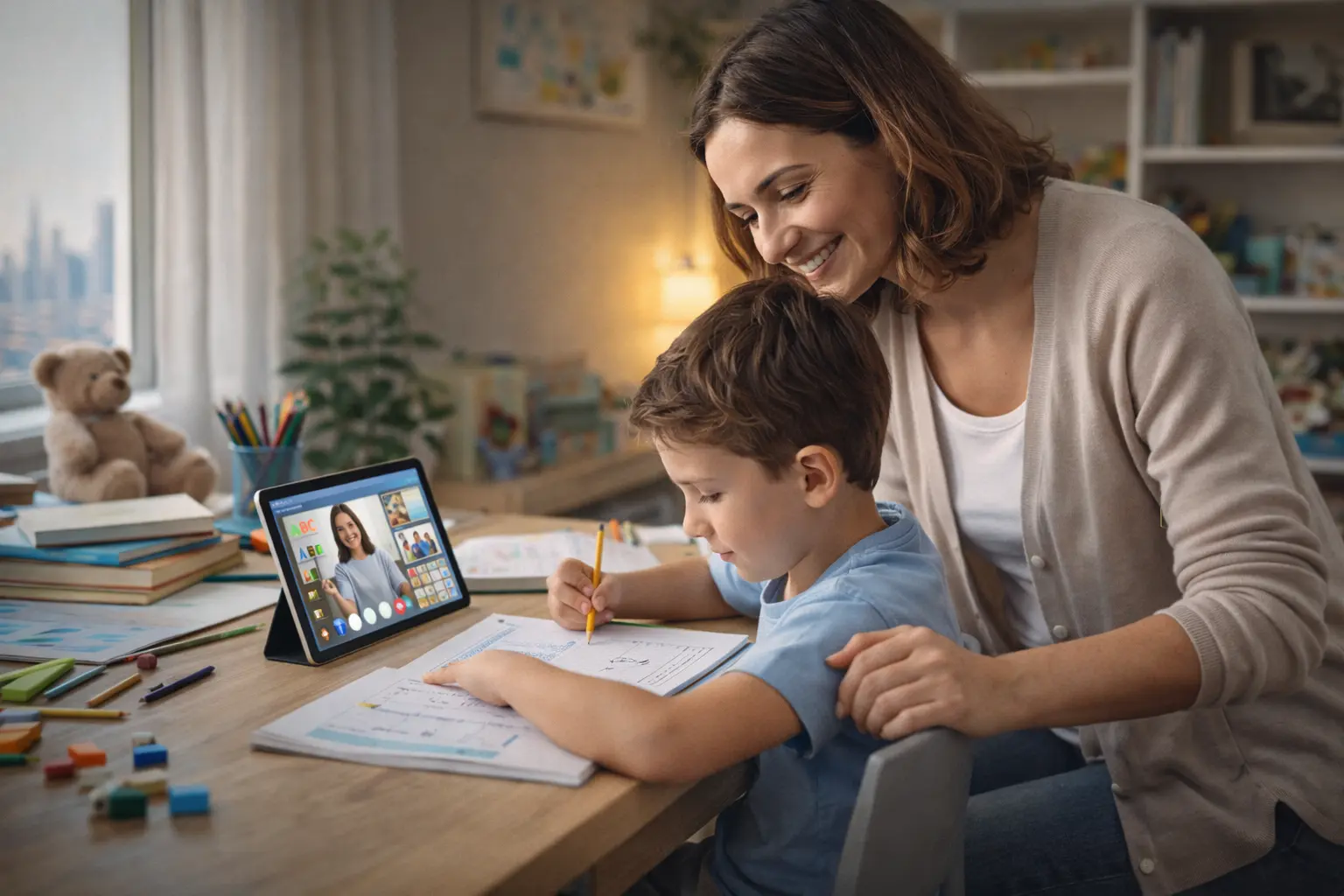
If you have a young child in Dubai and you’ve been wondering what your options look like when schools and nurseries shift to distance learning, KHDA just gave you a clearer answer.
The Knowledge and Human Development Authority has introduced new guidelines that allow home-based learning for children aged 0 to 6 during distance learning periods. It’s a meaningful shift in how early childhood education can be delivered in the emirate, and for parents of young children, it’s worth understanding properly.
Here’s what the guidelines actually say and what they mean for your family.
What KHDA Has Actually Introduced
The new rules give parents a structured, regulated alternative to nursery attendance when distance learning has been officially mandated.
Instead of sending children to a nursery — or trying to figure out remote learning on your own without any framework — parents now have two specific home-based models they can choose from. Both are regulated by KHDA and designed to maintain educational quality while offering flexibility.
This isn’t a permanent replacement for nurseries or early childhood centres. It’s an officially recognized option that can be activated during disruptions — and it comes with clear rules about when it applies and when it stops.
The Two Models Explained
Model One — Small Group Learning at Home
A small number of children can learn together in a home environment under supervision. Think of it as a structured, regulated setup where a few children from a neighbourhood or building come together for guided learning in a home rather than a classroom.
The group size is controlled, and the setup follows KHDA guidelines to ensure safety and quality standards are maintained. It’s not a free-for-all arrangement — it has specific requirements attached to it.
Model Two — Educator at Home
A qualified educator comes directly to the child’s home to provide learning support. This works well for families with one child or siblings close in age, offering a much more personalized experience than group settings.
The one-to-one or sibling-based approach means the educator’s attention is entirely focused on your child, which can be particularly beneficial for younger children who need more individual engagement.
Both options are built around maintaining educational continuity — the goal being that children don’t lose meaningful learning time during disruptions while staying in an environment where they feel safe and comfortable.
An Important Clarification — This Is Temporary
One thing worth being very clear about: this isn’t a pathway to permanently keeping your child out of nursery.
Home-based learning under these guidelines can only be used when KHDA has officially mandated distance learning across schools and nurseries. Once normal operations are permitted to resume, these home-based arrangements need to wind down within a defined period.
It’s a contingency framework, not a lifestyle choice. The distinction matters because some parents might read “home-based learning is now allowed” and interpret it more broadly than KHDA intends.
What Role Do Parents Actually Play?
This is probably the question most parents have first: Does this mean I’m suddenly expected to become my child’s teacher?
No. KHDA has been explicit about this.
Schools and nurseries remain responsible for planning lessons, delivering the curriculum, and tracking each child’s progress. That doesn’t change under the home-based model. What parents are expected to do is provide the environment, the structure, and the support that make learning at home actually work.
In practice, that means maintaining a daily routine, setting up a dedicated space for learning activities, limiting distractions during learning time, and staying in regular contact with your child’s educators.
That’s genuinely achievable for most families. You’re not being asked to teach phonics or run structured literacy sessions — you’re being asked to create the conditions in which a qualified educator or a structured program can do that work effectively.
Child Wellbeing Is Central to the Guidelines
KHDA has made it clear that early childhood education isn’t just about academic progress — and the home-based guidelines reflect that.
The framework emphasizes emotional and social development alongside learning outcomes. Young children, especially those under six, are heavily influenced by their environment and their sense of security. Learning in a familiar space, surrounded by people they trust, can reduce anxiety and improve engagement — particularly during uncertain or disruptive periods.
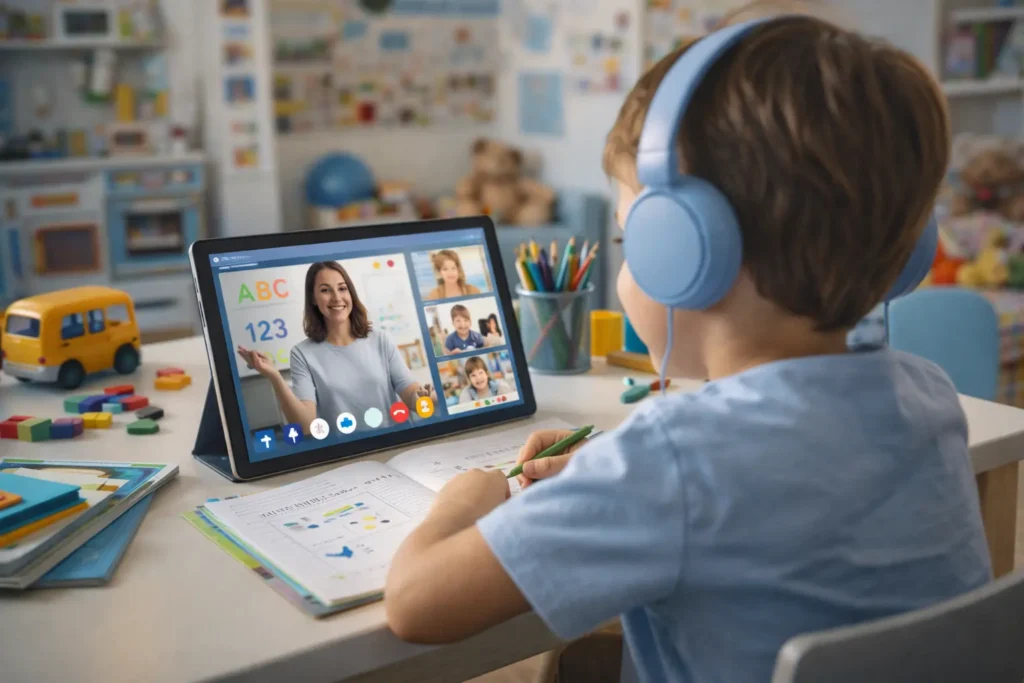
The guidelines also encourage parents to balance screen-based learning with offline activities. Play, reading physical books, creative activities, and outdoor time all remain important parts of a child’s development. The expectation isn’t that your child spends the day on a tablet — it’s that screen-based learning is one part of a varied daily routine.
How Nurseries and Educators Are Responding
Nurseries in Dubai aren’t stepping back from their responsibilities under this model — they’re adapting to deliver those responsibilities differently.
Most centres are developing digital tools and structured lesson plans that work effectively in a home environment. Regular feedback loops between educators and parents are becoming more formalized, with scheduled check-ins replacing the informal daily conversations that happen naturally at school pickup.
The collaboration between families and educational institutions is being treated as a feature of this model rather than a complication. Done well, it actually gives parents more visibility into what their child is working on and how they’re progressing than a typical nursery day provides.
Also Read: Dubai Launches ‘Shop and Park for Free’ Initiative: How Motorists Can Save on Parking
What Should Parents Think About Before Choosing This Option?
If you’re considering the home-based route when it becomes available, a few honest questions are worth sitting with:
Does your home setup realistically support structured learning? A dedicated space — even a corner of a room — where learning happens consistently makes a significant difference for young children who respond well to routine and environmental cues.
How much time can you realistically give? You don’t need to be a teacher, but you do need to be present enough to provide support, manage transitions between activities, and communicate with educators when things aren’t working.
Are your child’s particular needs well-suited to this format? Some children thrive in quieter, more personalized settings. Others need the social stimulation and structured environment of a group nursery to stay engaged. Knowing which category your child falls into helps you make the right call.
And practically — whichever model you choose, make sure it’s been set up in accordance with KHDA’s actual guidelines. An informal arrangement that doesn’t meet regulatory requirements doesn’t carry the same protections or quality assurances as a compliant setup.
The Bigger Picture
Dubai’s move here reflects something that education systems globally have been working through since 2020 — the realisation that learning environments need to be more adaptable than they traditionally have been.
Early childhood education has always been understood to extend beyond the classroom. Parents, home environments, and family routines are foundational to how young children develop. What KHDA has done is create a formal framework that acknowledges this reality and builds appropriate structures around it.
It’s a practical, thoughtful response to the unpredictability that has become a feature of modern life — and for parents of young children in Dubai, it provides a genuine option rather than just a gap where one used to be.