

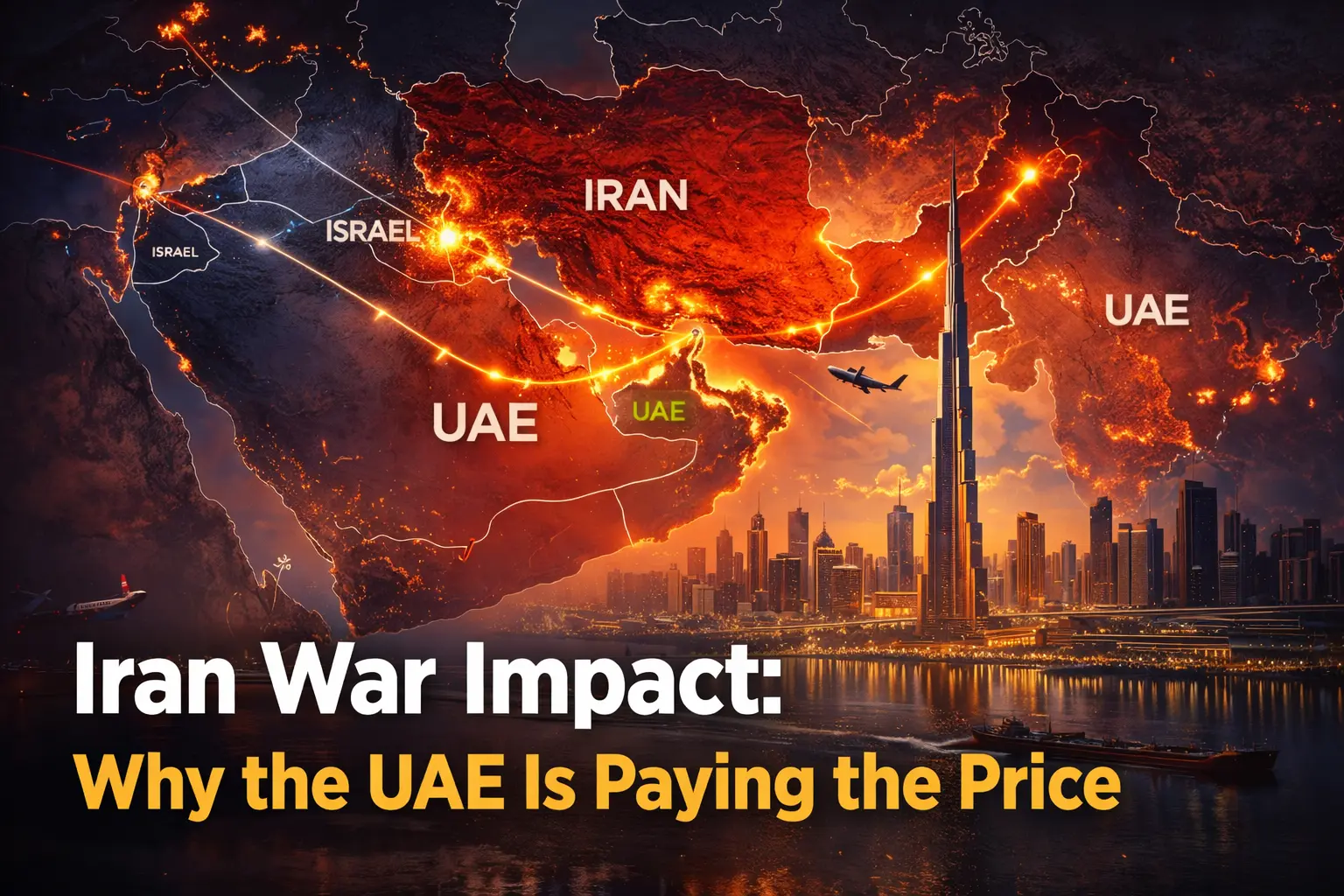
The ongoing conflict between the United States, Israel, and Iran has quickly expanded beyond its original battlefield. While the fighting is largely centered on Iran and Israeli targets, the impact of the war is spreading across the Middle East. One country feeling the consequences more than most is the UAE.
The UAE is not directly involved in the war, yet its economy, security environment, and aviation sector are being heavily affected. As the conflict continues, analysts say the Gulf nation is paying a significant price for a war it did not start.
Missile Attacks and Security Risks
One of the most serious impacts of the war has been direct security threats to the UAE. Following US and Israeli strikes on Iran, Tehran launched retaliatory missile and drone attacks across the region, including toward Gulf countries. These attacks triggered emergency air defense responses in the UAE.
According to official reports, hundreds of missiles and drones were launched during the escalation. Although many were intercepted by UAE defense systems, falling debris caused damage in areas of Dubai and Abu Dhabi and resulted in injuries and fatalities.
The strikes created fear among residents and prompted authorities to introduce heightened security measures across the country. Air defense systems were placed on high alert, and public safety advisories were issued to residents and businesses.
The UAE’s Unique Position in the Region
The UAE’s close economic ties with Iran make it particularly vulnerable to the consequences of the conflict. Despite political tensions between Iran and Western nations, the UAE has long maintained strong commercial connections with the Iranian market.
Trade between the two countries has grown steadily over the years. In fact, the UAE is one of Iran’s largest trading partners, with bilateral trade reaching tens of billions of dollars annually.
Dubai, in particular, has served as a major commercial hub for Iranian businesses and traders. Hundreds of thousands of Iranian residents live and work in the UAE, contributing to its economy and business ecosystem.
Because of these deep ties, any escalation involving Iran directly affects the UAE’s trade and financial networks.
Airspace Closures and Aviation Disruptions
The aviation industry in the UAE has also been significantly disrupted by the war. As missiles and drones were launched across the region, several countries temporarily closed their airspace for safety reasons.
The UAE is home to some of the world’s busiest aviation hubs, including Dubai International Airport and Abu Dhabi International Airport. When regional airspace becomes unstable, it immediately impacts global travel routes.
Airlines have been forced to cancel flights, reroute aircraft, and suspend certain services. Thousands of flights across the Middle East have been disrupted as a result of the conflict.
For a country whose economy heavily depends on tourism, international travel, and global connectivity, these disruptions have created serious economic pressure.
Rising Oil Prices and Global Energy Shock
Another major consequence of the war is the sudden rise in global oil prices. Tensions in the Middle East have threatened shipping routes through the Strait of Hormuz, one of the world’s most important energy corridors.
Around 20 percent of global oil shipments pass through this narrow waterway. When military conflict disrupts shipping in the area, energy markets react immediately.
Oil prices surged as tanker traffic declined and shipping companies avoided the region due to security risks. These disruptions have triggered volatility in global markets and raised concerns about energy supply stability.
For the UAE, which is both an oil exporter and a global trading hub, the uncertainty creates economic instability despite higher energy prices.
Impact on Trade and Shipping
The UAE’s economy depends heavily on international trade. Dubai’s ports and logistics networks serve as major gateways connecting Asia, Europe, and Africa.
When maritime routes in the Persian Gulf face security threats, shipping companies often delay or reroute vessels. The Strait of Hormuz crisis has already caused tanker traffic to fall sharply, with many ships avoiding the region entirely.
These disruptions slow down supply chains and increase the cost of transporting goods. Businesses across the Gulf are feeling the impact as shipping insurance costs rise and delivery timelines become uncertain.
Because the UAE functions as a global logistics hub, these disruptions directly affect its trade-driven economy.
Technology and Infrastructure Risks
The war has also highlighted the vulnerability of digital and technological infrastructure in the region. Reports indicate that drone strikes damaged several data centers in the UAE, causing disruptions to cloud computing services across the Middle East.
These data centers play a critical role in powering online services, e-commerce platforms, and digital business operations. When infrastructure is damaged during military conflicts, the ripple effects can impact companies across multiple industries.
The incident underscored how modern warfare can affect not only military targets but also digital networks that support global economic activity.
Also Read: Meet Dhiraj Jain: Dubai Businessman Who Helped Stranded Travelers During the UAE Crisis
Tourism and Investor Confidence
The UAE has spent decades building its reputation as one of the safest and most stable destinations in the Middle East. Cities like Dubai and Abu Dhabi attract millions of tourists and investors each year.
However, regional conflict can quickly affect public perception. Missile threats, airspace closures, and travel disruptions can cause tourists to reconsider travel plans.
Investor confidence can also weaken when geopolitical risks increase. Global businesses often prefer stable environments when choosing locations for investment or expansion.
For the UAE, maintaining its image as a secure international hub is crucial to its long-term economic strategy.
A War That Spreads Beyond Borders
Although the conflict between the United States, Israel, and Iran is focused on military targets and strategic objectives, its effects are spreading throughout the Middle East. Countries that are not directly involved in the fighting are still experiencing the consequences.
For the United Arab Emirates, the war has created a complex situation involving security threats, economic disruptions, and diplomatic challenges. From missile interceptions to trade disruptions and aviation chaos, the ripple effects of the conflict are being felt across the country.
As the war continues, the UAE remains one of the Gulf nations most exposed to its wider regional impact.